COLUMBUS, Miss. (CMSD) – Hunt Intermediate School students know it’s easy to identify a problem. Now, they are using new skills to solve problems and letting their imagination create new technology.
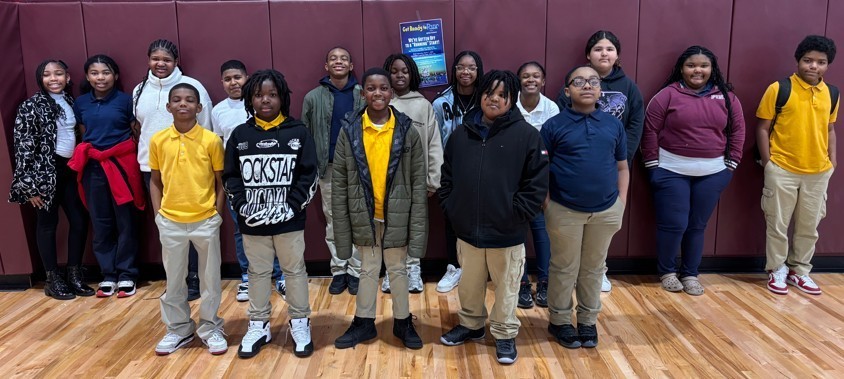
Two groups of sixth graders and one fifth grade group started with a challenge: think of a problem in your community and how can Artificial Intelligence solve the problem. It became a melting pot of ideas and challenges. The excitement was palpable.
“Watching this project come together was honestly one of the most rewarding experiences I’ve had as a principal. What stood out to me was that the students weren’t just learning about artificial intelligence, they were learning how to think. Our 5th and 6th graders had to identify a real community problem, discuss different perspectives, disagree respectfully, revise their ideas, and keep working when their first solution didn’t work. That is true critical thinking. They moved from “What is AI?” to “How can we use AI to help people?” and that shift is powerful. I watched students who normally don’t speak up become leaders in their groups. Some were the organizers, some were the researchers, some were the creative designers, and some were the problem-solvers when things fell apart,” said Hunt Intermediate School Principal Monte Ewing-Johnson.
The students were at the beginning stages of developing solutions to submit in the Presidential AI Challenge. President Donald Trump’s administration says the goal is to inspire kids and teachers to develop solutions facing communities across the nation.
One group settled on providing medication to the homebound, while the other thought of new ways to help law enforcement.
Daniel Rojas, a sixth grader, was excited to tackle the issue of helping the less fortunate heal with better medical care.
“Some people can’t drive or walk. They also might not be able to use Uber. We thought of a website or app that could help. People would be able to report their symptoms and their allergies. Then the app would send them the medication,” explained Rojas.
Tyzir Turner, also a sixth grader, looked to the streets. His group wanted to find ways to assist law enforcement, with the idea that police can’t be everywhere all the time.
“We decided to create bullet-proof cameras. They would scan people’s and use body language to help police solve crimes,” said Turner.
To watch students enthusiastically brainstorm and unite around an idea is something educators want to see in schools.
“I liked how they worked together. They presented the issues they saw as a problem in their community and then their peers challenged the answers to those issues. It made the groups of students go back and think of more solutions that worked, especially using AI,” explained Inclusion Teacher Jonathan Green.
“They learned that innovation is collaborative. No single student built the project, the team did. As a principal, the most meaningful moment wasn’t the final product. It was hearing them debate ethical concerns, fairness, accessibility, and safety. They began to understand that technology is not just about tools; it’s about responsibility. They were thinking like engineers, but also like citizens. This project showed me that when students are trusted with real problems, they rise to real expectations. They stopped working for a grade and started working for impact. That’s when learning becomes authentic. More than anything, I saw confidence grow. Students realized their ideas mattered, even at 10 and 11 years old. And when students believe their voices can improve their community, that’s when education does exactly what it’s supposed to do: prepare leaders, not just learners,” said Ewing-Johnson.
Educators say developing critical thinking skills beyond technology can have a direct impact in the classroom and strengthen academic performance. This is because students are no longer just memorizing text.
“The same mental process they used to evaluate an AI solution questioning accuracy, bias, and effectiveness is the process they use to determine the theme, author’s purpose, and evidence in literacy. We saw students begin to justify answers rather than guess them. Problem-solving improves mathematics achievement. Team building strengthens communication skills, which impacts writing and speaking standards. Most importantly, the project increased cognitive engagement. So academically, the benefit wasn’t separate from the curriculum it accelerated the curriculum. Students moved from completing assignments to using skills, and that shift produces measurable growth,” said Ewing-Johnson.
“A.I. is helpful. It can solve a math problem, but it doesn’t tell the student how to solve the problem. This is why developing critical-learning skills at a young age can help these students continue to grow in their academic journey,” said Green.
Some students do participate in the “We Build Better” class, where they create projects that test their building abilities, but this assignment was a little different.
“I was very excited but nervous,” said Rojas.
“It was fun. It seems A.I. can solve a lot of things but not everything,” recalled Turner.
The sixth graders entered their findings into the Presidential AI Challenge. Winners will be notified no later than April 1st. Regional winners will be invited to present their project in Washington during the summer.